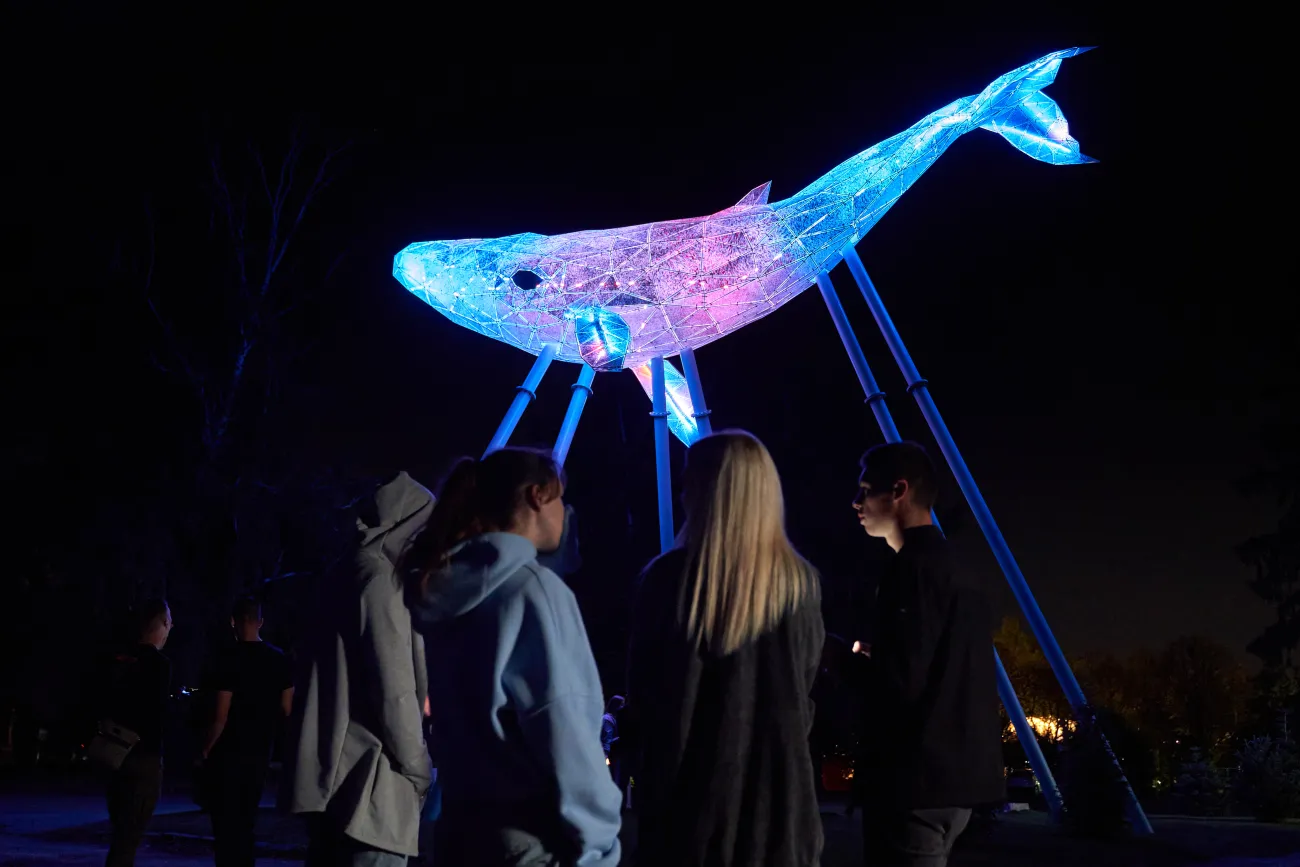
When the lights suddenly go out in Kyiv, the city doesn’t disappear – it changes shape. The outlines of buildings grow quieter, windows go dark, and the familiar signs stop setting the rhythm of the streets. In moments like these, you can hear what usually gets lost in the daytime noise: wind in the treetops, footsteps on wet asphalt, the distant rumble we’ve learned not to name out loud. And it’s precisely then that the Kyiv Whale can light up – not as a decorative whim, but as a sign that we are still able to speak about the future.
The Eco Hub around the Whale is being born in a country where the word “stability” sounds almost like nostalgia. Shelling, air-raid sirens, blackouts – these are not background and not abstraction; they are a daily calendar that can erase plans with a single notification. But there are things that cannot be postponed “until better times.” Water doesn’t wait. The river doesn’t pause. Nature never signed a ceasefire agreement with us.
We are building this project not in spite of the war, but alongside it – the way people learn to live alongside darkness. The Kyiv Whale in the night city reminds us: if we are fighting for the future, then we must also fight for what that future is made of. Not only for borders and buildings, but for water from the tap, for the river under the bridge, for the trees that will outlive us – if we don’t break the conditions that allow them to exist.
Eco Hub is an attempt to bring ecology back to human scale. Not “the planet” in the abstract, but the city you can touch: rain flooding an underpass, a storm drain clogged with a plastic bag, plastic disappearing from the sidewalk and turning up in the water. The project gives us a chance to stop and look honestly at the chains of cause and consequence we’ve learned to ignore.
At the heart of our idea are children – not as an audience to lecture, but as co-creators with a right to their own voice. We involve children and parents in events, talks, and workshops, and we don’t reduce the topic to poster-style morality. We try to explain complex things so they become clear and usable for action. When a child understands how a city treats its water, they stop being a passive observer. They begin asking adults questions – and that may be the strongest ecological tool we have.
Artists in this process are not “decorators” of science; they are its partners. They take facts, observations, experiments – and transform them into an experience you can live through. The exhibits are not created “for children,” but together with them: a child’s view of today’s world meets an artist’s perspective, and in that encounter a kind of honesty appears – without moralizing, but with a real sense of responsibility.
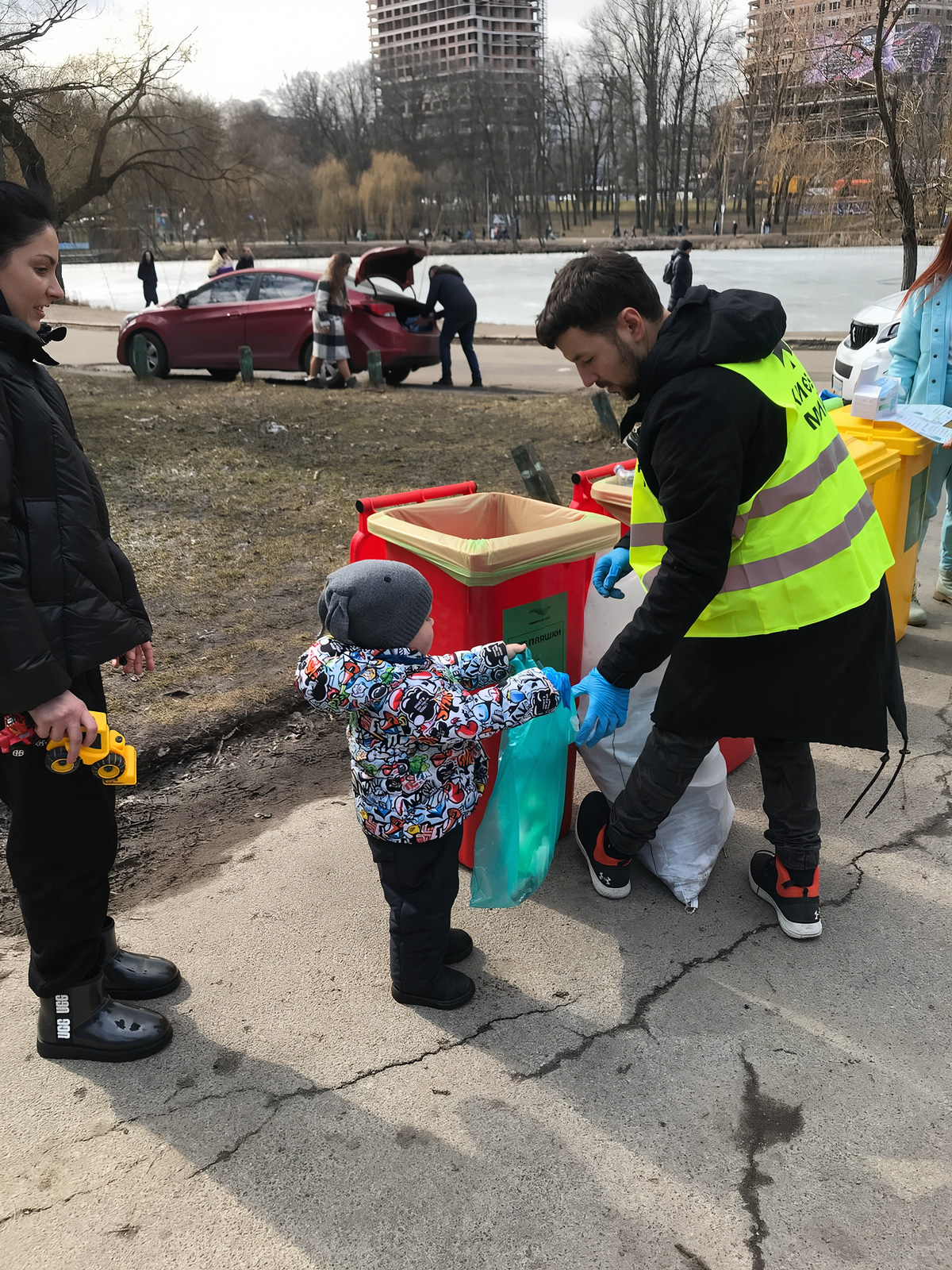
One of our workshops begins with a simple gesture – touching recycled plastic and trying to make something new from it. This is not a lesson “about sorting” and not a lecture about guilt. It is an exercise in imagination: we take a material that has already been trash and give it meaning back. Another workshop is about fungal mycelium – about materials that grow rather than being manufactured, about biology as the engineering of the future. Children look at a mycelium “framework” and suddenly see: technology doesn’t have to be only metal and plastic – it can also be living systems we can cultivate.
In these moments, Eco Hub becomes less about an “event” and more about a pause – a pause in which you can think about what matters. About the fact that clean rivers and clean water are not a topic for a fashionable season and not a grant trend. It’s something that unites us beyond politics and beyond time. A thousand years from now people will still drink water – or they won’t, if we don’t learn today to protect its sources. Water is the most honest archive of civilization: it remembers everything we pour into it.
During blackouts, this meaning is felt even more sharply. Darkness doesn’t let you get distracted by the unnecessary, and the Whale’s light becomes not just a pretty frame for a feed, but a beacon for attention. It seems to say: we are still here; we are still able to think; we are still able to build. Even when it feels like the only task is to make it to morning. During outages, the Whale will shine – and we want that light to be not about effect, but about hope and responsibility.

We know this path is not fast. But Eco Hub isn’t about speed. It’s about consistency – about how knowledge becomes habit, and habit becomes culture. About how, from small children’s hands that glue, sculpt, cut, and argue, grows adult responsibility. And about how adults – exhausted, pulled back together after sirens – still find the strength to come and support this process.
Here we will share the story of how the project develops: how the exhibits are born, how the themes of events take shape, how children’s questions and adults’ answers change. And also the quiet victories over indifference – the moments when someone first realizes that a river is not “somewhere out there,” but part of home.
We are building Kyiv Whale – Eco Hub because we believe: protecting nature is not something that comes “after victory.” It is part of victory itself. And if, in dark nights, the Whale will shine, it won’t be only because it can. It will be because we need a light that reminds us: our water, our rivers, our land – these are what we are holding on for.